About Cloud Atlas
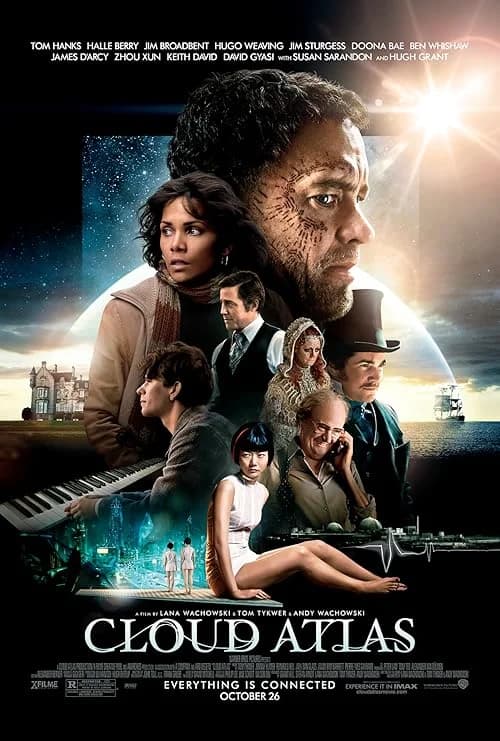
Cloud Atlas (2012) is a breathtaking cinematic achievement that weaves together six distinct narratives spanning from the 19th century Pacific Islands to a post-apocalyptic future. Directed by Lana and Lilly Wachowski alongside Tom Tykwer, this ambitious adaptation of David Mitchell's novel explores how individual actions ripple across time, connecting souls through centuries of human experience. The film's revolutionary structure features an ensemble cast including Tom Hanks, Halle Berry, Jim Broadbent, and Hugo Weaving playing multiple roles across different timelines, demonstrating how characters' essences reappear in new forms throughout history.
What makes Cloud Atlas truly remarkable is its profound exploration of interconnectedness—how love, courage, and oppression transcend individual lifetimes. The film moves seamlessly between genres, from historical drama to corporate thriller to dystopian science fiction, while maintaining a cohesive philosophical core about humanity's eternal struggle for freedom and connection. The technical execution is equally impressive, with each timeline featuring distinct visual palettes, dialects, and production designs that create immersive worlds while serving the overarching narrative.
Viewers should watch Cloud Atlas for its unparalleled ambition and emotional depth. Despite its nearly three-hour runtime, the film maintains compelling momentum as it builds toward a powerful conclusion about the enduring nature of human bonds. The performances are transformative, with each actor embodying multiple characters across race, gender, and age—a bold creative choice that reinforces the film's themes of universal humanity. Cloud Atlas challenges conventional storytelling while delivering a genuinely moving experience about how our smallest actions can echo through eternity, making it essential viewing for anyone who appreciates cinema that dares to explore life's biggest questions.
What makes Cloud Atlas truly remarkable is its profound exploration of interconnectedness—how love, courage, and oppression transcend individual lifetimes. The film moves seamlessly between genres, from historical drama to corporate thriller to dystopian science fiction, while maintaining a cohesive philosophical core about humanity's eternal struggle for freedom and connection. The technical execution is equally impressive, with each timeline featuring distinct visual palettes, dialects, and production designs that create immersive worlds while serving the overarching narrative.
Viewers should watch Cloud Atlas for its unparalleled ambition and emotional depth. Despite its nearly three-hour runtime, the film maintains compelling momentum as it builds toward a powerful conclusion about the enduring nature of human bonds. The performances are transformative, with each actor embodying multiple characters across race, gender, and age—a bold creative choice that reinforces the film's themes of universal humanity. Cloud Atlas challenges conventional storytelling while delivering a genuinely moving experience about how our smallest actions can echo through eternity, making it essential viewing for anyone who appreciates cinema that dares to explore life's biggest questions.