About Sweet Bird of Youth
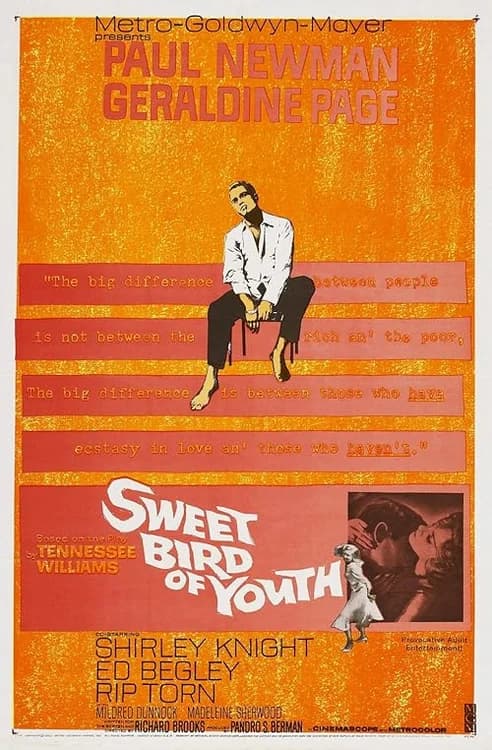
Sweet Bird of Youth (1962) is a compelling drama that explores the corrosive effects of regret and the relentless passage of time. Directed by Richard Brooks and based on Tennessee Williams' play, the film follows Chance Wayne (Paul Newman), a handsome but failed drifter who returns to his Southern hometown with Alexandra Del Lago (Geraldine Page), a fading, alcoholic film star fleeing a career disaster. Their arrival stirs a cauldron of bitter memories, particularly involving Chance's former love, Heavenly Finley, and her politically powerful, vindictive father, Boss Finley.
The film is anchored by two powerhouse performances. Paul Newman embodies Chance's desperate charm and hollow ambition, while Geraldine Page delivers an Oscar-nominated turn as the vulnerable, self-deluding Alexandra. Their symbiotic relationship—two damaged souls using each other as shields against reality—forms the emotional core. Richard Brooks' direction captures the sweaty, oppressive atmosphere of the small town, where the past is a prison.
Viewers should watch Sweet Bird of Youth for its sharp screenplay, masterful acting, and unflinching look at themes of aging, lost innocence, and the price of ambition. It's a quintessential example of 1960s Hollywood adapting serious theatre, offering both melodrama and psychological depth. The climactic confrontations remain powerful, making it a must-watch for fans of classic character-driven stories.
The film is anchored by two powerhouse performances. Paul Newman embodies Chance's desperate charm and hollow ambition, while Geraldine Page delivers an Oscar-nominated turn as the vulnerable, self-deluding Alexandra. Their symbiotic relationship—two damaged souls using each other as shields against reality—forms the emotional core. Richard Brooks' direction captures the sweaty, oppressive atmosphere of the small town, where the past is a prison.
Viewers should watch Sweet Bird of Youth for its sharp screenplay, masterful acting, and unflinching look at themes of aging, lost innocence, and the price of ambition. It's a quintessential example of 1960s Hollywood adapting serious theatre, offering both melodrama and psychological depth. The climactic confrontations remain powerful, making it a must-watch for fans of classic character-driven stories.